
How to Play Decoded: Rules, Examples and Winning Strategies
By GameBuddies Team — 2026-08-11
Decoded is GameBuddies.io's emoji-guessing party game: one player looks at a secret word, picks up to five emojis that hint at it, and everyone else races to type the word before anyone else does. There's no drawing, no acting, no talking around the clue — just icons on a screen and a countdown clock ticking while the rest of the room stares at the same handful of pictures trying to see what you saw.
That constraint is what separates Decoded from charades or Pictionary. You can't gesture your way out of a bad clue, and you can't add a caption to clarify. Five emojis, or fewer, have to carry the entire idea, which makes the game one of anticipation — the Describer predicts which combination will click for this specific group, and guessers think in the same associative shorthand the Describer is using. Because the emoji library runs past 1,700 icons across seven categories and five languages, the same secret word rarely gets described the same way twice, even by the same player.
Decoded works for groups of 3 to 16, runs entirely in the browser with built-in video chat, and supports two structurally different modes — Team Race, where a host judges every guess, and Free-for-All, where the Describer role rotates and judges its own round. Which one you pick changes the whole rhythm of a session, so it's worth understanding both before your group settles in.
Setting Up a Game
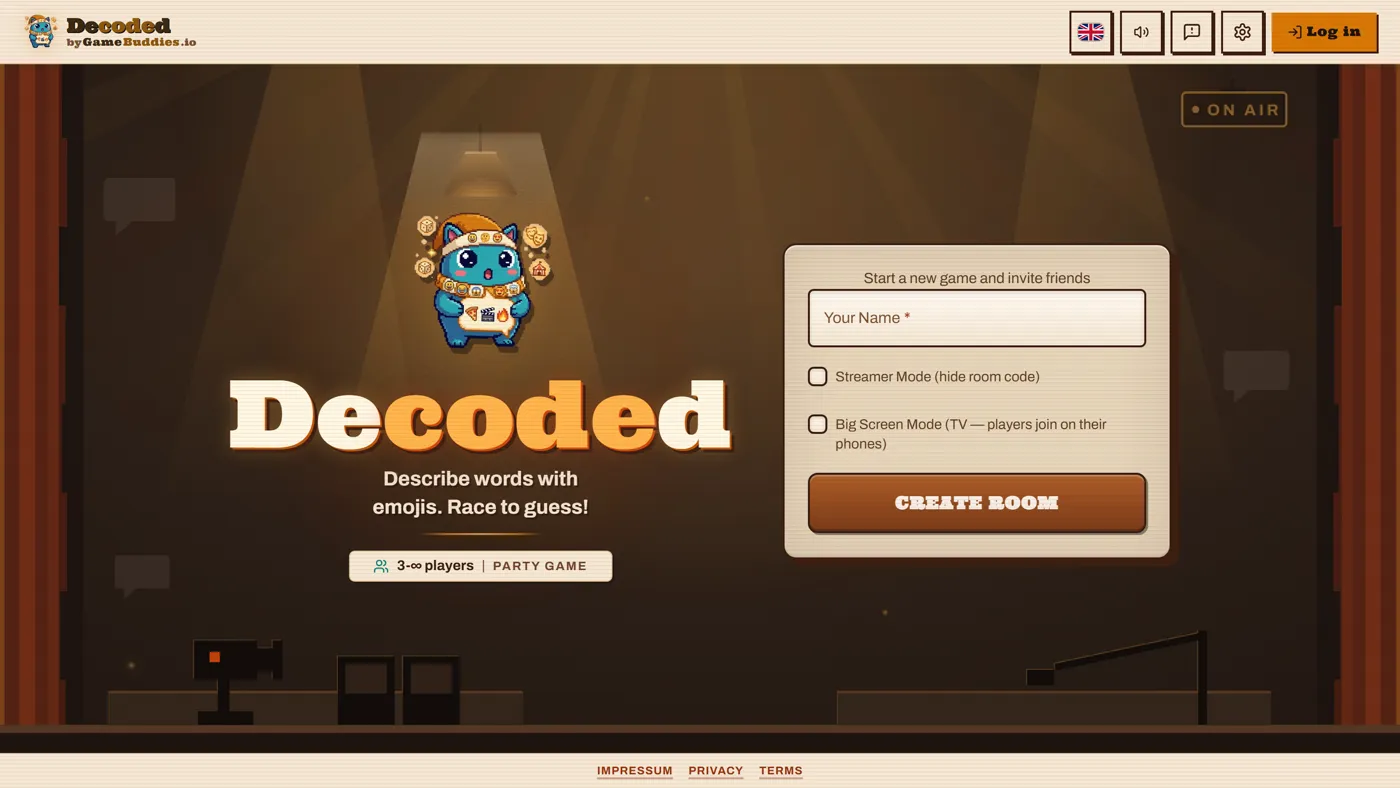
Like every GameBuddies.io game, Decoded starts with someone creating a room and sharing the join code with everyone else — no downloads, no accounts, nothing to install. Because the game runs with built-in WebRTC video chat, it's built for a cameras-on session: half the fun of watching someone squint at a handful of seemingly random icons is watching their face do it in real time.
Free-for-All can start with as few as 3 players, since the only requirement is that someone is the Describer and at least one other person is guessing. Team Race needs a minimum of 5, one host to judge plus two teams of two, because the mode is built around a dedicated judge role that Free-for-All doesn't have. According to the game's own data, the sweet spot for most groups sits at 4 to 8 players: enough people that guesses come from different angles, but not so many that half the room is waiting for their turn to type.
Before the first round, decide as a group whether you're playing Team Race or Free-for-All, and pick a language if your group isn't all English speakers — Decoded's word database covers English, German, Spanish, and both Brazilian and European Portuguese, so a mixed-language household or Discord server has options.
How a Round Works
- The Describer gets a secret word. They see it privately, along with a library of over 1,700 emojis pulled from one of seven categories: food, movies, places, actions, objects, people, or League of Legends champions, depending on what the room selected.
- They pick up to five emojis. No text, no sounds, just icons. They can use fewer than five if a tighter clue seems likely to land faster, or all five if the word needs more surface area to describe.
- Everyone else races to type the word. There's no penalty for a wrong guess, so the chat tends to fill fast with attempts, near-misses, and the occasional word nobody expected.
- The round gets judged. In Team Race, the host looks at each submitted guess and calls it correct or not. In Free-for-All, the Describer plays judge for their own round, deciding which guesses count.
- Points go out and the role rotates. The first three players to guess correctly score points, and so does the Describer. Next round, someone else becomes the Describer. Once the group's chosen number of rounds is up, whoever has the most points wins.
An Example Round
Say the category is food and the secret word is "sushi." The Describer doesn't get five guaranteed-perfect icons for this — that's the whole challenge — so they have to improvise from whatever's in the library that gets close. They might go with the fish emoji, the rice ball emoji, the chopsticks emoji, and the Japan flag emoji: four icons, each one narrowing the space a little more than the last.
The first icon alone, the fish, could mean a hundred things. Add the rice ball and the guessing pool shrinks to Japanese food specifically. Add chopsticks and it's almost certainly sushi, maybe onigiri. The flag is the Describer hedging — insurance in case "rice ball plus fish" reads as something else to a guesser who doesn't eat much Japanese food.
In the room, guesses start flying within seconds: someone types "ramen" and misses, someone else types "sushi" and gets it, taking first place. Two more guesses land shortly after for second and third. A guesser who was still typing "onigiri" doesn't get credited, since the round's already past third place, but nothing was lost by trying — wrong guesses never cost anything in Decoded. The Describer, watching the room decode their icons in real time, banks points too, and the role passes to the next player for the following round.
Strategy Tips
- Lead with the category-narrowing emoji, not the most literal one. A single icon rarely nails a word by itself, but the order you reveal information matters more than most players realize going in. Icons that cut the guessing space in half — a setting, a flag, a genre — are worth spending early, before the specific icons that only make sense once the category is locked in.
- Don't use all five just because you can. Every extra emoji is another data point guessers can use, sometimes in ways you didn't intend. If three icons already nail the word for most of the room, a fourth and fifth just give away information for free. Save them for words that genuinely need the extra surface area.
- As a guesser, type early and type often. Since wrong guesses cost nothing, there's no reason to sit on a hunch. The players who consistently land in the first three spots are usually the ones typing half-formed guesses the instant an icon combination suggests anything, not the ones waiting until they're certain.
- In Team Race, be careful what you say out loud. Because the game runs with open video chat, a team that talks through their guess before typing it risks the other team overhearing the answer. Coordinate quietly, or lean on text chat instead of voice for the actual answer.
- Watch for repeat patterns from the same Describer. Over a full match, most people default to a personal style — some lean on flags and settings, others go straight for literal objects. In Free-for-All especially, where the role rotates through everyone, learning a friend's emoji habits across rounds is a real, if slightly unfair, edge.
- If you're judging, decide your standard for near-misses before the round starts, not during it. Misspellings and close synonyms are going to come up, and a judge who flip-flops on how strict to be creates more arguments than the miss itself does.
Host Tips
Group size changes which mode makes sense. Free-for-All is lighter to set up — no dedicated judge, no team split — so it's the better default for casual groups of 3 to 6 taking turns describing. Team Race asks for more structure, a host willing to judge every guess, but rewards it with a genuine race dynamic that lands better with larger or more competitive groups.
If you're streaming, Decoded ships with a broadcast window built for OBS, a large-emoji display with a category badge for viewers, and toggles for round and score overlays. It's built to be watched, not just played.
Mixed-knowledge groups do better with the food, places, and objects categories; if your group doesn't follow League of Legends, skip that category rather than forcing it. A category nobody recognizes turns every round into a coin flip instead of a puzzle.
Common Mistakes
The most common Describer mistake is picking emojis that make sense to you specifically — an inside joke, a highly personal association — rather than emojis that map to how the word is commonly represented. Decoded rewards clues that are guessable by the room in front of you, not clues that are clever in isolation.
On the guessing side, the biggest mistake is overthinking instead of typing. Because wrong guesses are free, hesitation is pure cost with no offsetting benefit — every second spent second-guessing a hunch is a second a faster guesser can use to take first place.
New groups also sometimes chat about the emojis out loud before anyone commits to typing. That tips off the other team in Team Race mode, and it slows Free-for-All rounds down for no benefit.
Finally, don't sleep on judging consistency. A host or Describer who accepts a loose spelling in one round and rejects an equally loose spelling the next undermines the format faster than almost anything else — settle on a rule of thumb before round one and stick to it.
FAQ
How is Decoded different from charades or Pictionary? Decoded is entirely text-free and language-agnostic — you communicate in emojis instead of acting things out or drawing them. That makes rounds faster to learn and, since the word database supports five languages, playable across language barriers in the same room.
How many players do I need? Free-for-All works with as few as 3 people. Team Race needs at least 5, since it requires a host plus two teams of two. Most groups get the best experience at 4 to 8 players.
Can I use my own word list? Not currently. Decoded pulls from a curated database of over 1,700 words per language. Custom word lists aren't available yet, though it's on the roadmap.
What happens if I refresh my browser mid-game? Nothing bad — Decoded supports session reconnect, so refreshing mid-round drops you back into the game with your role and score intact instead of kicking you out of the room.
Do wrong guesses count against me? No. Guessing wrong costs nothing, so there's no reason to hold back a guess you're only half-sure about.
Play a Round
Decoded is free to play in the browser at gamebuddies.io/games/decoded — create a room, share the code, and turn your cameras on before the first Describer picks up their five emojis. If you're weighing it against other party games on the platform, the Decoded and Bluffalo introduction covers how it fits in, or browse the full games library to see what else runs in the same room.