

How to Play Schooled!: Rules, Example Round and Strategy for the Classroom Quiz Game
By GameBuddies Team — 2026-08-11
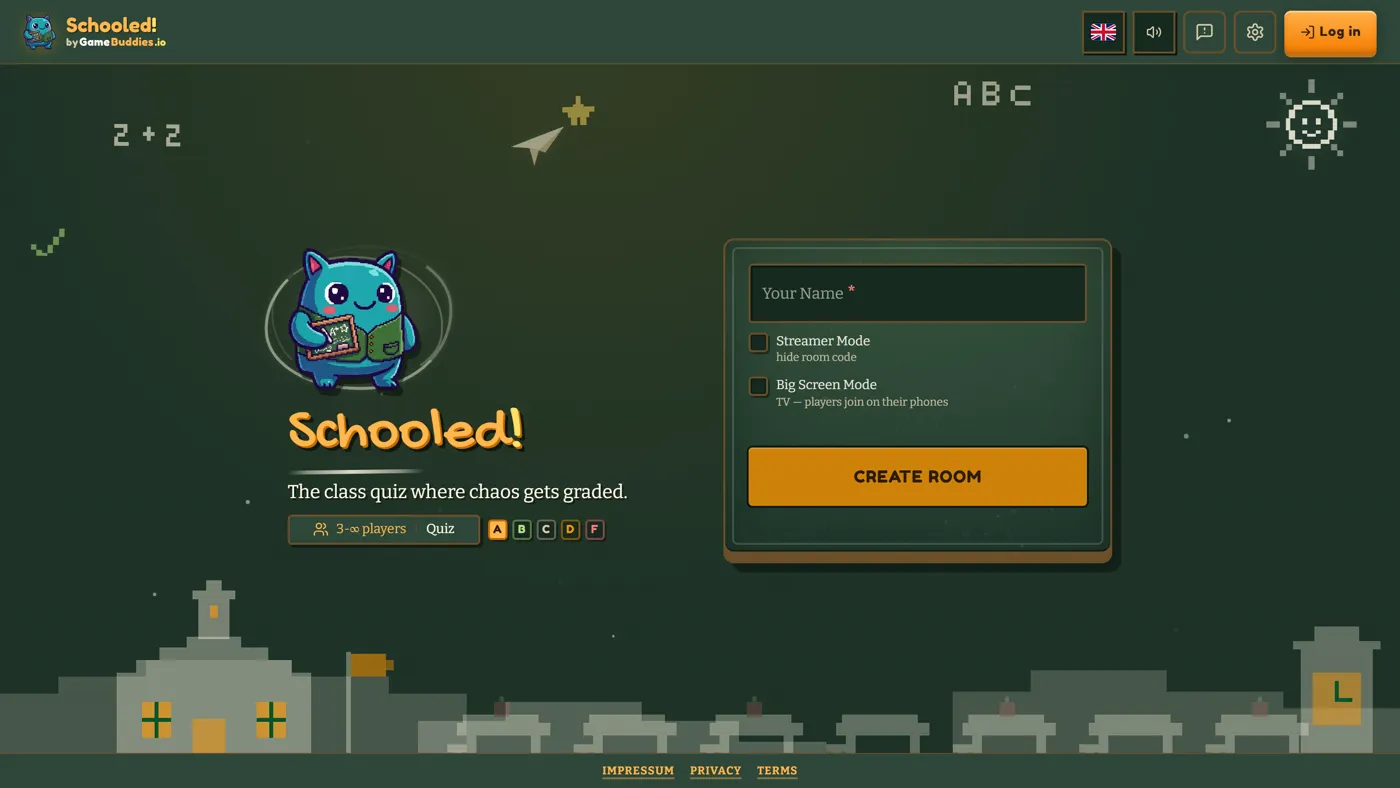
Schooled! is GameBuddies.io's classroom-style quiz game: a Game Master asks a question, and instead of buzzing in or typing an answer into a box, everyone else draws their answer on a virtual chalkboard. You can write text, sketch a picture, or blend both, which turns even a plain trivia question into a small performance, since half the fun is watching what your friends draw when "explain this in ten seconds with a mouse" is the actual assignment.
The game runs in two structurally different modes. Survival gives every player three lives; a wrong answer costs one, and it keeps going until only one player is still standing. Points mode drops the elimination pressure entirely — everyone stays in, and whoever has racked up the most correct answers by the end wins. Layered on both modes is Community Voting, which hands the "was that answer right" call to the room instead of leaving it to the Game Master alone, plus a Joker system giving every player a small set of get-out-of-trouble powers to spend across the game.
Because it scales from a tight 3-player game night up to a 30-player group, Schooled! ends up used in two different settings: casual game nights with friends, and literal classrooms, where a teacher runs the Game Master seat for a class period.
Setting Up a Game
A host creates the room, shares the join code, and everyone else gets in from their own device — phone, tablet, or laptop, no download required. Because players draw their answers, a touchscreen or a comfortable mouse makes for a noticeably better experience than a laptop trackpad, so it's worth flagging in advance if precision matters for your questions.
Before the round starts, the host configures the game mode (Survival or Points), sets timers, decides how many Jokers each player starts with (anywhere from 1 to 5), and picks which Joker types are in play. Someone also takes the Game Master role — they can just run the show, creating or selecting questions, or play alongside everyone else while also managing the flow.
How a Round Works
- Pick your mode before you start. Survival gives everyone 3 lives and ends when one player is left standing; Points mode scores every correct answer and the highest total wins. The host also sets timers and Joker rules at this stage.
- The Game Master asks a question. They create or select it, and can choose to answer along with everyone else in the room rather than just running the game from the sidelines.
- Everyone draws their answer. The chalkboard accepts text, freehand sketches, or a mix of both — there's no single correct way to answer, just whatever gets the idea across before time runs out.
- The room judges the answer. If Community Voting is switched on, every player votes on whether a given answer counts, and the majority rules. With voting off, the call comes down to the Game Master.
- Jokers get spent when it matters. Each player holds a small pool of Jokers that can skip a question, unlock a hint, or grant some other configured advantage — spend them, don't hoard them, since unused Jokers carry no value once the game ends.
An Example Round
Picture a Points-mode game with Community Voting on, five players, and a Game Master sitting out to just run the show. The question goes up: "Name a country that borders Germany."
Two players write it out plainly, "France," "Poland," clean and legible. A third player sketches a rough national flag next to the word "Austria," which reads fine but takes a beat longer to parse than the plain text. A fourth player, running low on time, scribbles something half-finished that could be "Netherlands" or could be an accident.
When the boards get revealed, the room votes. "France" and "Poland" pass instantly, no ambiguity, majority correct. "Austria," flag sketch included, also passes, since the drawing plus the word together make the answer unambiguous even if it took an extra second to read. The half-finished scribble splits the room: some players are generous and vote it as "Netherlands," others aren't sure what they're looking at and vote no. It falls short of a majority, so it doesn't count. Points get handed out to the three clear answers, and the Game Master moves to the next question.
Strategy Tips
- Match your answer style to the question, not your own habits. A fact-based question, a date, a name, a country, is almost always safer answered in plain text — legible beats artistic when the room is about to vote on whether they can even tell what you wrote. Save the sketching for questions that are genuinely visual or open to interpretation, where a quick drawing communicates faster than a sentence would.
- When Community Voting is on, write for skimmers. Your answer gets maybe a second or two of attention before the room votes. An answer that needs explaining after the fact has already lost votes it could have kept with clearer handwriting or a simpler sketch.
- In Survival mode, don't burn your last life on a guess you don't believe. With only 3 lives and no way to earn more mid-game, the players who last the longest tend to be the ones who use a skip Joker on a genuinely unknown question rather than gambling a wrong answer they weren't confident in.
- Save at least one Joker for the back half of the game. Early questions in a session are usually the ones where confidence is highest and mistakes are cheapest. Spending your whole Joker pool in the first few rounds leaves you with nothing in reserve once questions, or nerves, get harder.
- If you're the Game Master and choosing to play too, write questions you'd genuinely want to answer. Since the Game Master can participate rather than just officiate, the games that stay sharpest tend to be the ones where the GM picked content they find interesting rather than just filler — enthusiasm on one side of the board tends to spread.
- Track who's close to elimination in Survival mode. A player on their last life plays differently than one with lives to spare — expect desperate players to lean on Jokers and cautious answers, and adjust your voting instincts on their submissions accordingly.
Host Tips
Schooled! scales unusually wide for a party game: the range runs from 3 players up to 30, which is why it shows up in actual classrooms as often as in game nights. For large groups, think a full class, Points mode tends to beat Survival: elimination means early losers just sit and watch, which gets old fast in a 25-30 person room. Save Survival for smaller, competitive groups where being knocked out doesn't mean half an hour of downtime.
Community Voting is worth turning on for anything subjective — creative prompts, opinion questions, ambiguous trivia — since it spreads the judgment call across the room instead of one Game Master. For strictly factual quizzes with one right answer, leaving it off keeps the pace tighter.
Joker count, 1 to 5, is a good dial for difficulty: fewer for a sharp, competitive group that wants real stakes, more for a classroom or mixed-skill group where you want fewer players knocked out over one hard question. Running recurring sessions with the same class or standing game night? The premium custom question packs let you build sets tailored to exactly what you're covering.
If you're broadcasting the session, Schooled! includes a broadcast window built for OBS.
Common Mistakes
The single biggest mistake is treating the chalkboard like a canvas instead of a message. A gorgeous, detailed drawing that takes the full timer to finish and is hard to parse in the two seconds before a vote will lose to a plain, fast, legible answer almost every time. The chalkboard rewards clarity, not effort.
On the Game Master side, ambiguous questions are the most common source of frustrated votes — one with more than one reasonable correct answer turns Community Voting into a coin flip about phrasing rather than a check on knowledge. If you can picture two totally different, equally valid drawn answers, tighten the question before you ask it.
Groups also frequently misjudge which mode fits their size. Survival with a large or mixed-skill group means a chunk of players are eliminated early and just watch; Points mode keeps everyone in it until the end, almost always the better call for bigger or more casual sessions.
Finally, don't ignore Jokers until it's too late. A skip or a hint spent on a question you were about to get wrong anyway is a life or a point saved for free — treat unused Jokers at the end of a game as a missed opportunity, not a badge of toughing it out.
FAQ
What are the two game modes? Survival gives every player 3 lives; a wrong answer costs one, and the last player standing wins. Points mode has no elimination — every correct answer scores points, and the highest total when the game ends wins.
What is Community Voting, and should we turn it on? When it's on, every player votes on whether a given drawn answer counts, and the majority decides. It's a good fit for subjective or creative questions where one person's judgment call would feel arbitrary. For straightforward factual quizzes, leaving it off keeps rounds moving faster.
What are Jokers, and how many do we get? Jokers are configurable powers — skipping a question or getting a hint are the two the game describes, plus other advantages the host can enable. The host sets how many each player starts with, from 1 to 5, which is a simple way to make a session more forgiving or more competitive.
Can the Game Master play too? Yes. The Game Master can create or select questions and manage the flow of the game while also submitting their own drawn answers alongside everyone else.
How many players can actually play at once? Schooled! supports as few as 3 players for a tight game night and scales up to 30, which is part of why it gets used in real classrooms and not just casual groups.
Play a Round
Schooled! is free to play in the browser at gamebuddies.io/games/schooled — create a room, pick a mode, and let someone volunteer for the chalk. If you're setting this up for an actual classroom or a large group session, the guide to classroom games online has more on running group activities like this one, or check the full games library for other quiz and drawing games that run in the same room.