

How to Play Tier Battle: Rules, Scoring and Strategy for the Ranking Party Game
By GameBuddies Team — 2026-08-11
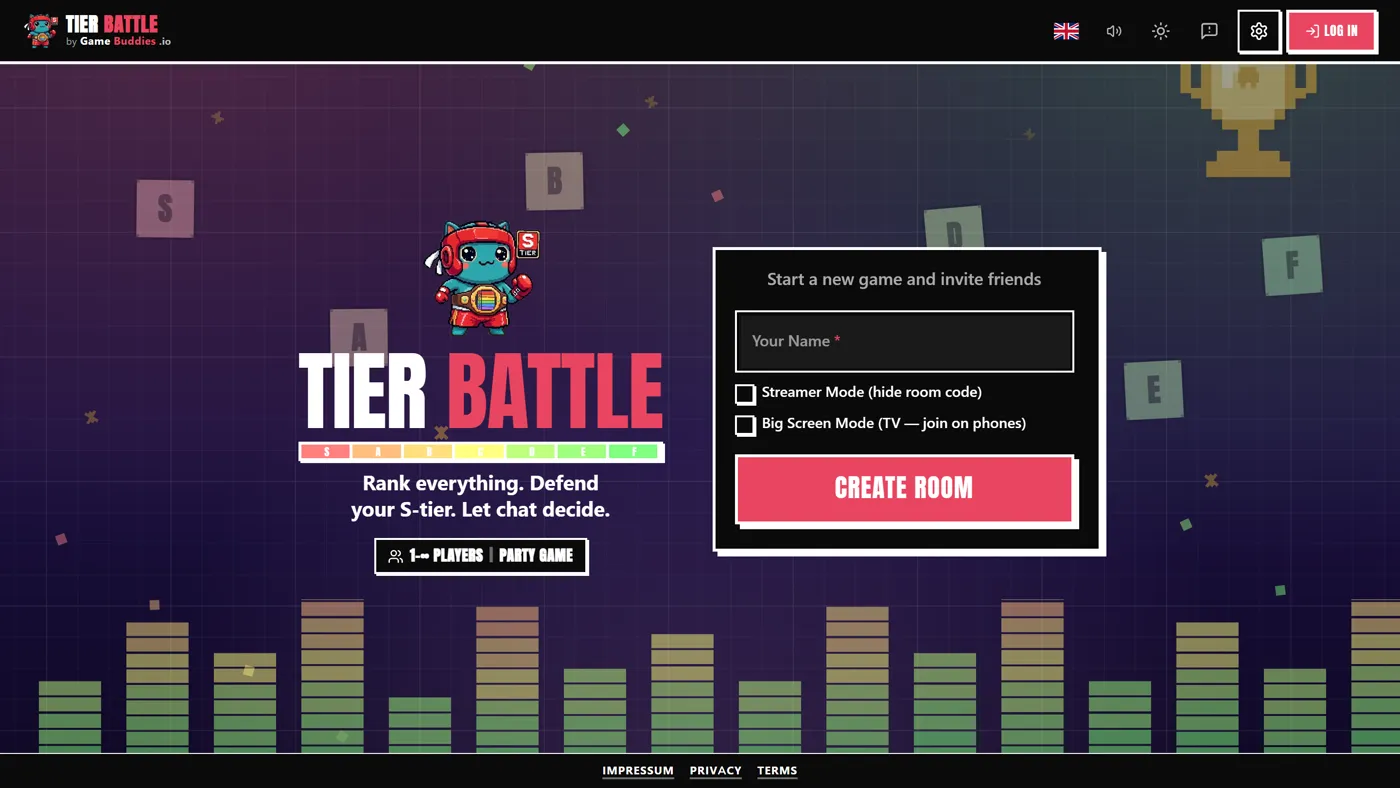
Tier Battle is GameBuddies.io's ranking party game: pick a category, drag a pile of items into S-through-F tiers, and then find out, all at once, whether your S-tier pick was everyone else's F-tier joke. It plays for 1 to 12 players, including solo, since a single player can rank a category against a Twitch chat instead of against other people in the room.
What makes Tier Battle more than a shared spreadsheet is the reveal. Everyone ranks blind, at the same time, with no idea what anyone else picked, and once the timer runs out there are no takebacks. Then every list goes up together, the group figures out what the "true" ranking actually is, and a scoring system called Mind Meld rewards you for how close your list landed to that consensus, not just whether you got it exactly right.
The category system is where most of the personality shows up. The game ships with seven curated categories, including pizza toppings, Pixar movies, Disney villains, and Zelda games, but any group can invent their own, and the game explicitly rewards divisive item choices over safe ones: an item everyone agrees on doesn't generate an argument, and the argument is the point.
Setting Up a Game
A host creates a room and shares the join code — the usual GameBuddies.io setup, no download or account required, playable from a phone, tablet, or laptop. Tier Battle runs with built-in WebRTC video chat, which matters more here than in most party games, since watching someone's face when their S-tier pick gets voted straight down to F is most of the entertainment.
If you're streaming, you can connect your Twitch channel so chat votes on the truth directly. Without Twitch connected, the game falls back to a player vote instead — someone still has to decide what "true" means for the round, and that job moves from chat to the group. Either way, the category and item-adding phase moves fast: adding items takes only about 30 seconds per round, so there's little setup drag before ranking starts.
How a Round Works
- Pick a category. Choose from the curated list, pizza toppings, Pixar movies, Disney villains, Zelda games, and others, or invent your own on the spot. Players then add the items everyone will rank; the more divisive the items, the better the round plays out.
- Drag items into tiers. S down to F, all at once, blind to what anyone else is doing. Once the timer runs out, your list is locked, no going back to fix a placement you're second-guessing.
- Reveal everything and vote on the truth. Every player's tier list goes up at the same time. With Twitch connected, chat votes on the real ranking using commands like "!1 S" or "!2 A" for each item. Without Twitch, players vote on whose list was the best overall, and that list becomes the round's truth — its creator becomes the round's Curator.
- Score the Mind Meld. Every item you ranked gets compared to the truth. An exact match on tier is worth 5 points, one tier off is worth 3, two tiers off is worth 1. Whoever scores highest for the round earns a Round Champion bonus of 10 points, and matching every single item exactly earns a Perfect Round bonus of 15.
An Example Round
The category is Disney villains, and the room has settled on three items to rank: Scar, Ursula, and Gaston. Everyone ranks blind and the timer runs out. With Twitch connected, chat votes on the truth: Scar lands in S, Ursula in A, Gaston in C.
One player had ranked Scar in S, an exact match, 5 points. They'd put Ursula in S as well, one tier off from the A-tier truth, worth 3 points. Gaston went into B for them, also one tier off, another 3 points — 11 points from three items before bonuses. If that total is the highest at the table, they pick up the 10-point Round Champion bonus too, and if they'd matched all three items exactly instead of just one, they'd have earned the 15-point Perfect Round bonus instead.
Meanwhile, another player who'd put Ursula down in F, well past "two off" from the A truth, scores nothing for that pick. That's the tension the game is built around: a bold, extreme placement pays off if you're reading the room correctly, but pays nothing once you're more than two tiers from wherever the group, or chat, lands.
Strategy Tips
- Rank for the group's consensus, not your own opinion. Mind Meld scores you on distance from the truth, not on being "right" in some objective sense. If you personally think an item belongs in F but you suspect the room or the chat will land on B, ranking closer to B scores better than ranking your honest opinion.
- Know who you're predicting for. A Twitch chat vote and a small friend-group vote consensus rarely land the same way — chat tends to reward chaotic, joke-driven extremes, while a friend group voting on the "best list" tends to reward defensible, well-argued placements. Read the room you're actually in, not the room you assume you're in.
- Use the middle tiers to hedge on items you're unsure about. Because one-tier-off and two-tiers-off placements still score points, a cautious B or C placement on an item you're not sure about is safer than a confident S or F guess that could land in the zero-point zone if you're wrong.
- In player-vote mode, remember the Curator bonus rewards persuasion, not just accuracy. The list voted best earns its creator a bonus for being picked, and a bold, clearly-argued list can win that vote even against a technically more "correct" but forgettable one. If your group votes on the best list rather than using Twitch, being interesting is part of the strategy.
- Don't rank on autopilot when the timer is short. Items only take about 30 seconds to add per round, and the ranking phase moves at a similar pace. Since there are no takebacks once time runs out, it pays to place your most-confident items first and spend any remaining seconds on the genuinely uncertain ones.
- If you're playing solo against Twitch chat, learn your channel's voting culture. Some chats vote sincerely, some vote for the funniest possible outcome regardless of accuracy. After a round or two you'll have a read on which one you're dealing with, and you can weight your own placements accordingly.
Host Tips
Tier Battle flexes from a solo stream segment up to a 12-person group session, and ideal size depends on what you're optimizing for. A 5-round game runs roughly 10 to 25 minutes with 4-5 players, making it easy to run two or three categories back to back in one hangout.
For streamers, connecting Twitch turns the reveal-and-vote phase into a live audience segment — chat votes the truth directly with simple numbered commands, giving viewers a reason to be in chat during the reveal. Pair it with the OBS broadcast window if it's part of a wider stream.
Without Twitch, the game still needs someone to anchor the "truth" for each round, so that falls to a player vote instead. It's worth reminding first-time players that this vote decides the round's scoring baseline, not just picks a favorite — take it as seriously as the ranking itself.
Categories are the biggest lever a host has over how good a session feels. The seven curated options are a safe, fast starting point, but a custom category built around your specific group's shared references — a show everyone's watched, foods everyone has opinions about — tends to produce sharper disagreements and better rounds than a generic list ever will.
Common Mistakes
The most common mistake is adding items nobody actually disagrees about. Tier Battle explicitly rewards divisive picks, and a category full of items everyone would rank the same way turns the reveal into a formality instead of an argument, which defeats the entire premise of the game.
Players also frequently misread the scoring and either play too safe or too reckless. Clustering everything in the middle tiers to "play it safe" caps your upside, since exact matches score more than near matches; going the opposite direction and gambling every item into S or F caps your downside protection, since anything more than two tiers off scores nothing at all. The scoring rewards genuine, considered predictions more than either extreme strategy.
Running Twitch mode with a very small or inactive chat is another common mistake — if only a couple of viewers are voting, "chat's verdict" ends up decided by two people rather than any real consensus, which undercuts the reveal.
Finally, don't spend the ranking phase second-guessing a placement you've already locked in. There are no takebacks once the timer runs out, so time spent debating yourself instead of moving to the next uncertain item is time you don't get back.
FAQ
Do I need Twitch to play? No. With Twitch connected, chat votes on each round's true tier list using commands like "!1 S" or "!2 A." Without Twitch, players vote on whose tier list was best, and that list becomes the round's truth — its creator gets a bonus for being voted best.
How long does a game take? About 10 to 25 minutes for 5 rounds with 4-5 players. Adding items to a category takes roughly 30 seconds per round, so setup doesn't eat into playing time much.
Can I really play Tier Battle by myself? Yes — Tier Battle supports solo play, using your Twitch chat as the judge instead of other players in the room.
How does Mind Meld scoring actually work? Every item you ranked is compared to the round's truth. An exact tier match scores 5 points, one tier off scores 3, and two tiers off scores 1. The highest scorer for the round gets a 10-point Round Champion bonus, and matching every item exactly earns a 15-point Perfect Round bonus.
What happens if we don't use Twitch — who decides what's "true"? Players vote on which tier list was the best overall, and that becomes the round's truth. The player whose list wins the vote becomes the round's Curator and gets a bonus for it.
Play a Round
Tier Battle is free to play in the browser at gamebuddies.io/games/tierbattle — create a room, pick a category, and find out who in your group has genuinely unhinged pizza-topping opinions. For more on how it stacks up as a group activity, see the guide to playing a multiplayer tier list game with friends, or browse the full games library for other party games in the same room.