

How Tier Battle Works: The Multiplayer Tier List Game Where Twitch Chat Decides the Tiers
By The GameBuddies Team — 2026-05-11
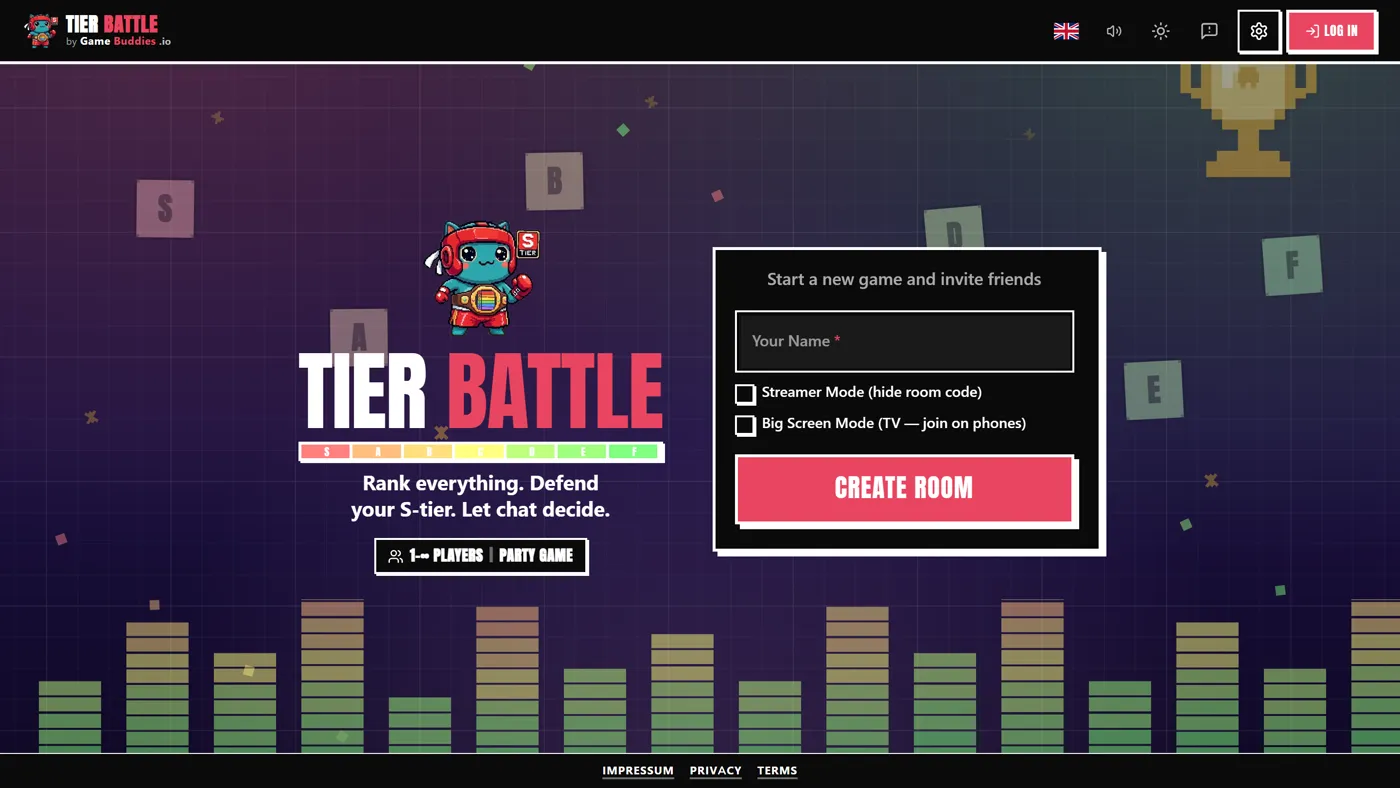
The thing nobody tells you about tier lists is that the fun isn't in making them. It's in defending them in front of four other people who think you're wrong about pineapple. Tier Battle is the multiplayer version of that conversation — a free, browser-based multiplayer tier list maker for 2 to 12 players where everyone ranks the same items at the same time, then the room (or a connected Twitch chat) votes on whose list was actually right.
It's the missing half of every tier-list site you've ever used.
Why a tier list game needs a winner
Solo tier-list tools like TierMaker stop at "share the screenshot." Tier Battle adds the part that matters: someone has to be right. Every round, an external judge — Twitch chat aggregating votes, or one player whose list the room voted "best" — defines the canonical tier order. Then everyone else's tier list gets scored against it.
The scoring system is called Mind Meld, and it rewards being close, not just being right:
| Outcome | Points per item |
|---|---|
| Exact tier match | 5 |
| 1 tier off | 3 |
| 2 tiers off | 1 |
| 3+ tiers off | 0 |
On top of that, the player with the highest item-score for the round gets +10 (Round Champion), anyone who matched the truth on every voted item gets +15 (Perfect Round), and the Curator (in the no-Twitch mode) gets +20 just for having the room agree with them.
The Mind Meld curve is what turns Tier Battle from a personality test into a game. You're not trying to predict your friend's tier list — you're trying to predict the consensus, which means putting pineapple in C instead of F even if you secretly hate it. The tactical layer is "what do I think the room will think," not "what do I think."
How a round actually plays
A full game takes 10–25 minutes for 5 rounds with 4–5 players. Each round runs through five phases:
Category select (lobby only, once). The host picks 1 to 12 categories from the curated deck (Pizza Toppings, Pixar Movies, Disney Villains, Zelda Games, Olympic Sports, Breakfast Foods, Weather) or invents custom topics. Anything goes — "podcasts about true crime," "fast-food fries," "Pokémon starter Pokémon." The more divisive, the better.
Item submission. Players fill the category with items. Five items minimum, fifteen tops. Dupes auto-reject; near-duplicates ("Mcdonalds" vs "McDonald's") get a soft warning. This is where most of the laughs land — somebody is going to submit "lukewarm tap water" for Breakfast Foods and you have to live with it. The submission timer is host-configurable per game.
Ranking (blind). Each player drags every item into one of seven tiers — S, A, B, C, D, E, or F. You only see your own list. No takebacks once the timer runs out or the host advances the phase. The ranking grid runs full-screen so you can drag confidently on mobile.
Reveal. Every player's list shows up at once. The big grid in the middle shows the round's truth tier — either chat's aggregated vote or the Curator's list. Mini-grids around it show what each player placed.
Score. Mind Meld points apply, bonuses stack, the round's Round Champion gets called out, and the scoreboard updates. Then the next round starts.
After your configured number of rounds (host picks 1–10, default 5), the game ends and you get a final standings card you can share — pineapple defenders identified, friendships intact (mostly).
The two "truth" modes — Twitch chat or Voted Curator
Tier Battle has one mode, but two ways to source the round's correct answer:
With Twitch connected. The host enters a Twitch channel name in the lobby, and chat becomes the judge. During each round's reveal, chatters vote for an item's tier with simple commands — !1 S, !2 A, !3 F. Each chatter only gets one vote per item per round; subsequent picks overwrite their previous one (no ballot stuffing). The aggregated chat tier list becomes the round's truth, and Mind Meld scores against it.
This is the streamer-friendly mode. It works as a live audience-engagement bit: chat votes, players score, and the round's truth gets dictated by whoever's watching.
Without Twitch (Voted Curator mode). No streamer? No problem. After everyone reveals, all players see each other's tier lists and vote for whichever one they think is "most right" — best taste, funniest takes, whatever criterion they want. The winning list becomes the round's truth, the player who made it gets called the Curator, and they pocket a flat +20 bonus for being the room's chosen authority.
Curator mode is the version friends use without an audience. It rewards being a tastemaker. You can play to be objectively right or to write the funniest tier list — both score, because the room decides what "best" means.
Categories that actually work
Some categories are great for tier lists. Others are sticky pits where everyone places everything in A. Categories you'll want to use:
- Food-with-feelings. Pizza toppings, breakfast foods, pasta shapes, sandwich condiments. These have a strong opinionated middle (mayo: S? F?) where Mind Meld scoring really moves.
- Pop culture from a specific era. Disney villains, 90s sitcoms, MCU phase 4 movies — narrow enough that everyone has takes, broad enough that 8+ items show up.
- Things-that-shouldn't-be-ranked. Weather, days of the week, types of clouds. The humor comes from defending the rank with a straight face.
Categories that flop:
- "Best Pokémon" — too broad, you'll get 15 items submitted and run out of submission time
- Anything with a clear-cut consensus — "best Tarantino movies" is fun for the first three picks, then everyone agrees and Mind Meld scoring collapses to 5s for everyone
When inventing a custom category, aim for 6–10 items worth of opinions and at least one divisive third rail (the pineapple-on-pizza of that category). That's where Tier Battle earns its keep as a tier list game with friends rather than just a ranking exercise.
Tier Battle vs TierMaker
TierMaker is great if you want to make a static image and post it. It's a single-player tool: drag items, save the PNG, tweet the result, done.
Tier Battle is the multiplayer counterpart. The differences that matter:
| Tier Battle | TierMaker | |
|---|---|---|
| Players | 2–12 real-time | 1 |
| Outcome | Scored game, winner declared | Static image |
| Truth source | Chat vote or Curator vote | Whatever you decided alone |
| Categories | Player-supplied items, curated category prompts | Pre-built templates |
| Twitch integration | Yes (!1 S voting) |
No |
| Browser-only | Yes, no account | Yes, no account |
| Cost | Free | Free |
The short version: if you want to make a Pokémon tier list to argue about on Twitter, TierMaker. If you want to make a Pokémon tier list while arguing about it with friends in a live video chat, Tier Battle.
Player-count breakdown
- 2 players. Works as a head-to-head — both players make tier lists, then Voted Curator picks one (well, each player votes; tiebreaker goes by score). Tight, no audience, ~15 minutes.
- 3–5 players. The sweet spot. Enough perspectives for Voted Curator mode to feel democratic, fast enough that nobody waits long for submissions. Curator changes every round, so the game has a built-in spotlight rotation.
- 6–12 players. The "panel show" zone. Use Twitch mode if you have an audience; if not, Voted Curator still scales because the votes form a clearer majority. Pace it at 3–5 rounds instead of the default 5 — 12 people taking turns producing items adds up.
- Solo + Twitch chat. You vs your chat. Stream a Tier Battle and let viewers rank with you; Mind Meld scores you against their aggregate. Surprisingly compelling content.
Other free party games in the same room
Tier Battle lives in a room you can reuse — finish a round, hop into another game without re-inviting anyone:
- Canvas Chaos — drawing party game with Twitch voting. Same vibe, different brush.
- Bluffalo — bluffing trivia. You write fake answers, the room votes on what's real.
- Decoded — emoji-based charades. Communicate the word using only emojis, race to guess.
Browse the full catalogue or the free browser games shelf for everything we ship.
What this looks like in practice
Five friends, one room, Pizza Toppings as the first category. Player A puts pineapple in S. Player B puts pineapple in F. The other three split. Twitch chat builds its own tier list in parallel — each chatter votes on individual items (!1 S, !2 A, …) and the aggregated result becomes the round's truth. Pineapple lands in S on chat's list by a ~63% margin. Player A's S placement matches exactly: 5 points on pineapple. Player B is two tiers off: 1 point. Player A's total for the round is highest, so they're called Round Champion (+10). Player B picks up the friendship pieces and moves on to round 2: Disney Villains. Player B places Hades in F because "he's not even trying."
Friendships end. Mind Meld scores diverge. Someone eventually wins. The game-over screen shows the final standings, the full tier list per round, and a screenshot you can share that captures the entire forensic argument.
That's Tier Battle. Free, multiplayer, browser-only, no sign-up. The online tier list ranking game for the part of game night where everyone needs to take a side.
FAQ
How many players can play Tier Battle at once?
Tier Battle supports 2 to 12 active rankers per room, and as many spectators as you want. Two players make for a tight head-to-head; 4–6 is the sweet spot for arguments; 8+ becomes a panel show. Solo play is allowed only if you connect a Twitch channel — chat then acts as the second player.
Do I need Twitch to play Tier Battle?
No. With Twitch connected, chat votes the round's official tier list using !1 S, !2 A, !3 F commands. Without Twitch, players vote on whose personal tier list was best — the winner becomes the round's Curator, their list is treated as the truth, and they get a +20 bonus on top of normal scoring.
How does Tier Battle scoring work?
Mind Meld scoring rewards being close, not just being right. You score 5 points for placing an item in the exact same tier as the round's truth (chat or Curator), 3 points for being one tier off, and 1 point for being two tiers off. Higher bonuses stack on top: +10 for the round's highest item-score (Round Champion), +15 for a Perfect Round (every item matched exactly), and +20 if your list got voted the Curator.
Can players add their own items to a category?
Yes — that's the whole game. Categories like "Pizza Toppings" or "Disney Villains" are prompts; players fill them in during a host-configurable submission phase each round. The more divisive the items, the better the argument. Dupe protection blocks "pineapple" from being submitted twice; near-duplicates get gently rejected.
How is Tier Battle different from TierMaker?
TierMaker is a solo tier-list builder — one person drags items, shares a static image. Tier Battle is multiplayer in real time: everyone ranks the same items simultaneously, blind to each other's picks, and the room collectively (or Twitch chat) decides whose list was right. You can also play it free in your browser without an account.