

Bad Actor Strategy: How to Survive as the Imposter (and Catch One in 60 Seconds)
By GameBuddies Team — 2026-07-17
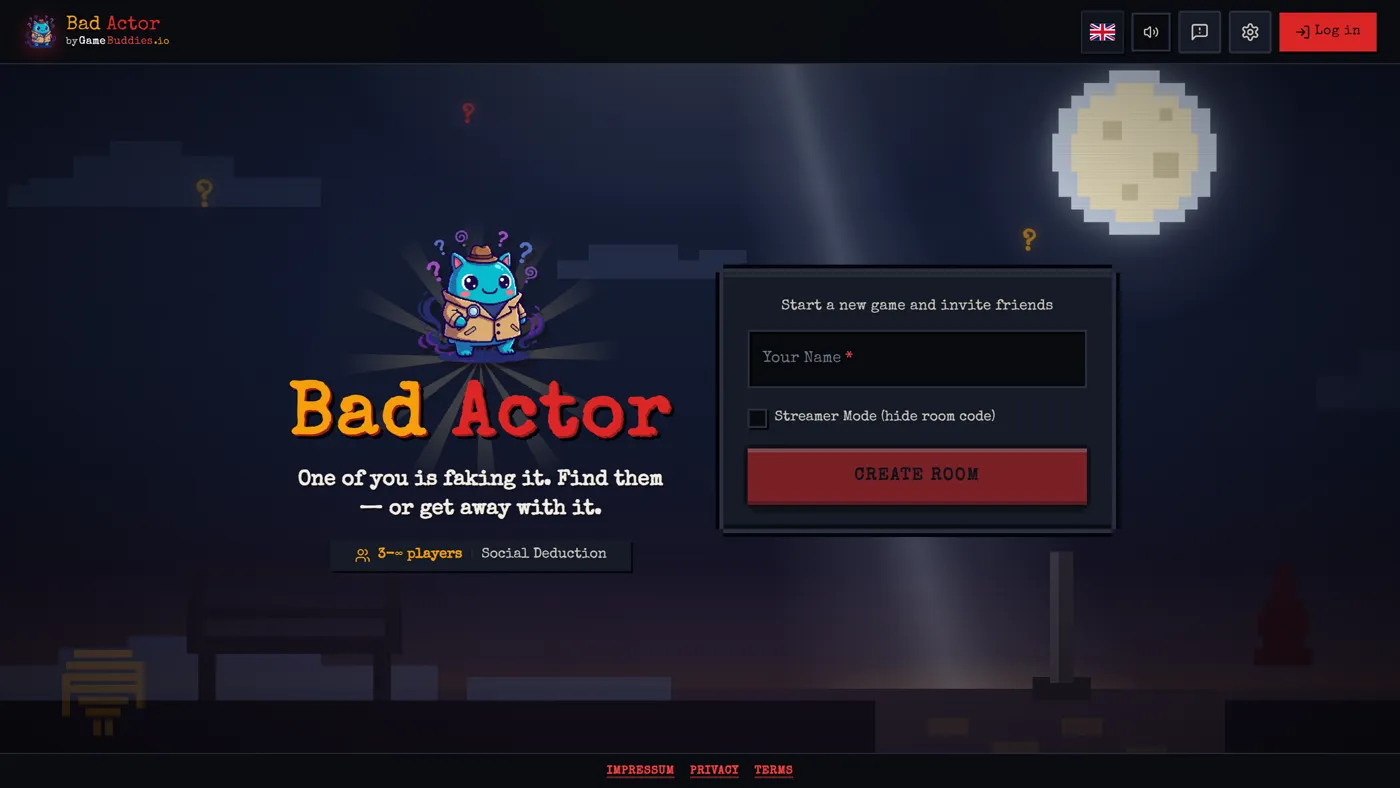
Bad Actor is our social deduction game built around a brutally simple constraint: one word per turn. Everyone except the imposter receives the same secret word. On your turn you have 30 seconds to say a single word that proves you know the secret — without giving it away to the one player who doesn't. Then 60 seconds of open discussion, a vote, and the reveal.
That one-word constraint is what makes the game hard, and it's why generic "how to play imposter games" advice doesn't work here. You don't get sentences to hide in. Every word you say is evidence. Here's what we've learned about playing both sides well.
The clue-giver's dilemma (this is the whole game)
Every innocent player faces the same trade-off each turn: a clue specific enough to prove you're not the imposter, but vague enough that the imposter can't triangulate the word from it.
Go too vague — say "thing" or "big" — and you look exactly like an imposter fishing for safety. Go too specific and the imposter now has enough to bluff perfectly for the rest of the round. The best clue is one that only makes sense once you know the word: an association from a different direction than the previous clues, obvious in hindsight, useless in advance.
A good habit: before your turn, ask what the imposter could do with the clues already given. If the first two clues have already boxed in the category, your job is to add confirmation for insiders without adding information for the outsider — reference a detail, not the category.
Playing imposter in Classic mode: mirror, don't lead
In Classic mode you know you're the imposter, but you have no word. Your entire toolkit is other people's clues.
- Never go first with confidence. If you're early in the turn order, play the vagueness line as close as you dare and watch reactions rather than words — on camera, innocents relax when a clue lands inside the word's orbit.
- Echo the axis, shift the angle. If clues suggest something cold, wet and outdoors, don't say another weather word — the imposter repeating the established category is the most common tell. Pick a word one associative step away from the cluster, not from any single clue.
- Bank your credibility for the discussion. The 60-second discussion decides the vote, and confident, early accusations from you set the agenda. The imposters who survive aren't the quiet ones — they're the ones running the investigation.
Hidden mode: the paranoia engine
Hidden mode is our favorite twist: the imposter receives a different word and doesn't know they're the imposter. Everyone plays sincerely — one player is just sincerely wrong.
This changes both jobs completely. As an innocent, you're not looking for evasion anymore; you're looking for someone whose clues are confidently pointing somewhere else. Their clues will be good clues — for the wrong word. The tell isn't vagueness, it's a subtle, consistent drift.
And here's the mind-bending part: if the clues around the table stop making sense to you, entertain the possibility that you are the one with the different word. The players who win Hidden mode are the ones who can hold "maybe it's me" in their head while still giving useful clues. The moment you realize it might be you, your strategy flips mid-round from proving yourself to quietly hedging — without alerting the room that you've noticed.
Truth mode: lying without the question
In Truth mode, players answer questions out loud — but the imposter never sees the question and has to improvise an answer from everyone else's. It's the closest the game gets to pure improv.
If you're the imposter here, the two survivable strategies are:
- Answer late and shallow. Let two or three real answers define the space, then give a low-detail answer in the same register. Detail is your enemy — every specific you invent is a specific that can contradict the question.
- React like an audience member. Innocents' reactions to each other's answers carry information about what the question was. Laughing at the right moments is camouflage.
For innocents, the counter is asking-by-answering: give an answer that's clearly responsive to a detail of the question. Imposters can mimic tone; they can't mimic content they never saw.
The 60-second discussion: where innocents throw games away
Most innocent losses happen in the discussion, not the clue rounds, and they happen the same way: the group anchors on the first loud accusation and stops testing it. With only 60 seconds, one confident wrong take eats the whole clock.
Better use of the minute:
- Replay clue order, not clue quality. Ask "whose clue only works if they'd already heard someone else's?" Derivative clues are the strongest imposter evidence in the game.
- Make the suspect explain a connection. An innocent can instantly say how their word links to the secret. An imposter explaining a bluffed clue has to invent the connection live — on camera, with everyone watching, that half-second of construction is visible.
- Don't waste time on the vague first clue. Everyone's first clue is cautious. It's the later clues, given with more information on the table, that separate the roles.
Group size and the social meta
Bad Actor runs with 4–10 players and plays best at 5–8. Smaller groups make every clue count double; bigger groups give the imposter crowds to hide in but more clues to trip over. And like every social deduction game, the real long game is your standing group's meta: the friend who always over-explains when innocent, the one who only accuses when guilty. Bad Actor rounds are short — the reads compound across a whole evening.
Play a round
Bad Actor is free in the browser at gamebuddies.io — no download, no accounts. Create a room, share the 4-letter code, and turn cameras on: this is a game about faces, and the built-in video chat is where half the tells live.
Related: Virtual game night ideas · Party games for big groups · Bad Actor game page
Related Reading
- How to Win Bluffalo: The Art of Writing Lies Your Friends Will Vote For
- Free Games to Play With Your Twitch Chat (No Bot, No Extension, No Download)
- Twitch Community Games: What They Are, How Viewers Join, and 8 Free Formats to Run
- How to Host a Community Game Night on Twitch (Setup, OBS, Chat Commands, Moderation)