Free Online Multiplayer Games for 4+ Players (No Sign-Up Required)
By The GameBuddies Team — 2026-08-02
Free online multiplayer games for groups of 4 or more are harder to find than you'd think. Most "multiplayer" on free game sites means "you play against one random stranger," which doesn't help when you actually want to play with three friends and a cousin on Discord. The games below all support 4+ players in a private room with a shared code, and none of them make you sign up to start a round.
This guide is specifically about group multiplayer — 4 people or more, all in the same game, sharing a room code. If you're looking for smaller group picks or solo browser games, we've got separate guides for the 20 best free browser games and party games for game night.
What makes a good free online multiplayer game for 4+ players?
Three things separate a game that actually works for a group of 4+ from a game that looks like it should:
1. The game doesn't stall when it's not your turn. If every round is "one person does a thing while four people watch," the group loses attention by round three. The best group multiplayer games have everyone doing something simultaneously, or at least let you see the current player's work in real time.
2. It scales without breaking pacing. A game that feels great at 4 players can feel dead at 10 (too many spectators) or at 4 players can feel too fast (not enough room to strategise). We tested all the picks below at 4, 6, 8, and 10-player counts.
3. There's no awkward host setup. The host shouldn't have to install software, create an account, "verify their email," or grant permissions. Open the game, click "create room," get a code, share it. Every game in this list works that way.
The 10 best free online multiplayer games for 4+ players
1. Canvas Chaos (3-12 players)
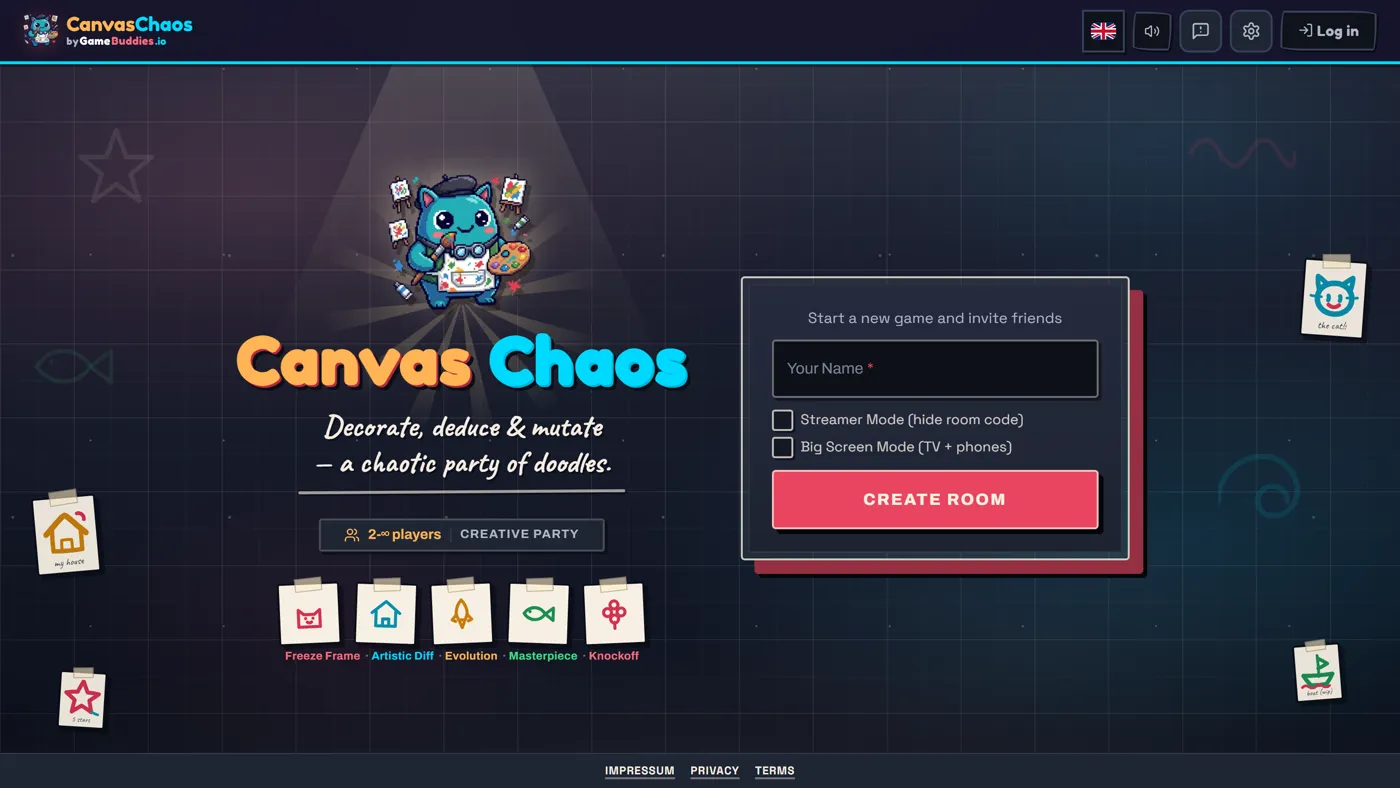
Canvas Chaos is the one most groups start with. It's a collaborative drawing and guessing chain: you get a prompt, you draw, then your drawing passes to the next player who has to describe it, then that description passes to someone else who has to draw it. By round 5 the original prompt has mutated into something nobody can trace back to the start.
The reason it works at 4+ players specifically: every player is doing something every round. There's no waiting. And the "reveal" at the end (where the game walks through the full chain) is genuinely funny in the way that only group games can be — the payoff is collective.
Scales well to: 6-10 players. Over 12 the chains get too long to stay coherent.
2. Last Brain Standing (2-10+ players)
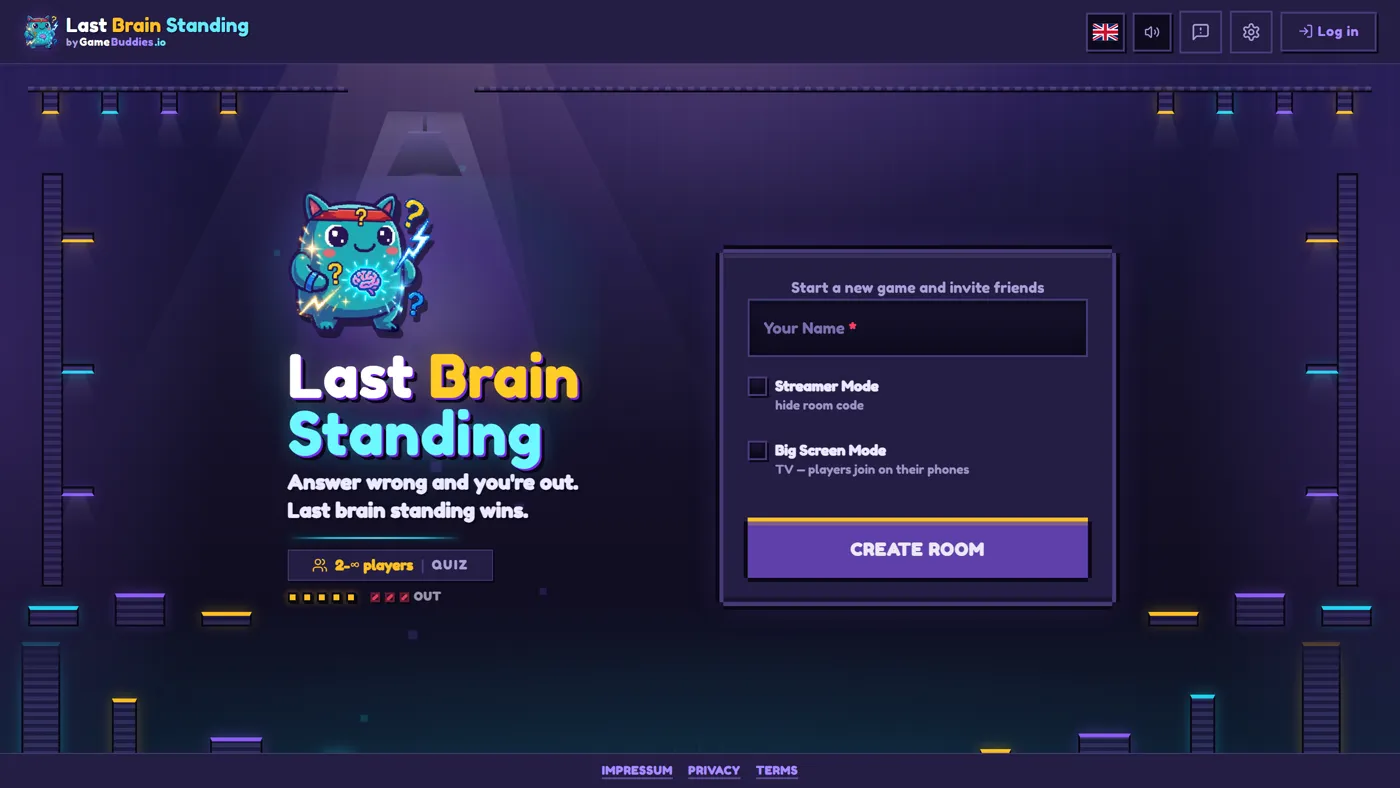
Last Brain Standing is competitive trivia without a quizmaster. Everyone answers the same question at the same time, wrong answers eliminate you, and the last player standing wins. It's Kahoot if Kahoot had a battle-royale mode and didn't need a teacher.
Good for group multiplayer because the format is inherently competitive — nobody's sitting out waiting, everyone is racing. And the elimination mechanic means the game gets shorter as you go, which is exactly what you want when people are losing focus.
Scales well to: up to 12. Above 12 it still works but individual questions feel less personal.
3. Bad Actor (4-12 players)
Bad Actor is browser-based social deduction. One player is secretly the impostor — they have different info from the rest, and their goal is to blend in. Everyone else has to figure out who's lying. Think Mafia without the wait times, or Among Us without the platformer layer.
The 4-player minimum is because you need enough suspects for the game to have tension. Below 4, the impostor is always too obvious. Above 8, the game turns into chaos in the best way.
Scales well to: 6-10. The 10-12 player games are the ones you'll talk about later.
4. Bingo Buddies (2-50+ players)
Bingo Buddies is customisable bingo. The host writes the card topic (pop culture references, movie tropes, things your team lead says in every meeting) and every player gets their own card. This is the only game on this list that scales past 12 without slowing down — we've seen it run at 40+ players for all-hands meetings and virtual holiday parties.
Not as interactive as the other picks (bingo is bingo), but it's the answer to "we have 20+ people and need one game."
Scales well to: anything up to 50+ players.
5. Schooled (3-30+ players)
Schooled was built for classrooms — the host can run trivia rounds with 30+ students and see everyone's progress in real time. For friend groups and office game nights, the classroom features translate surprisingly well. There's a structured scoring round, a host dashboard, and enough scaffolding that a non-gamer can run the game without losing control.
Scales well to: 30+. The best pick if your group is "too big for a normal party game but too small for Bingo Buddies."
6. ThinkAlike (2-8 players)
ThinkAlike is a word-matching game — you score points by writing the same answer as your teammates instead of writing something original. The category prompt is broad ("a type of fruit," "80s films," "things you'd find in a toolbox") and scoring rewards shared thinking.
The reason it makes this list even though it starts at 2: it's one of the few small-group games that also works at 6-8 players without becoming a mess. Great for mixed-size groups where you don't know the headcount until people show up.
7. Hot Potato (3-16 players)
Hot Potato is the fast-paced pick. A visual "potato" gets passed between players while a timer runs; whoever's holding it when the time ends is eliminated. Before you can pass the potato, you have to answer a short prompt.
Rounds are 3-6 minutes, which makes it a great warm-up game at the start of a session or filler between longer games. And because players are eliminated sequentially, you can start with 16 people and finish with one in about 10 minutes.
8. Prime Suspect (2-6 players)
Prime Suspect is a card-based deduction game with a detective theme. Each card has a specific ability (the Inspector lets you guess another player's card, the Butler lets you peek, the Murderer has to stay hidden), and you play one card per turn. Last detective in the round wins the token; first to a target number of tokens wins the case.
Works for 4 players specifically because the card pool and ability interactions hit their best balance at 3-5 players. At 6 it still works; at 2 it's slightly too predictable.
9. ClueScale (3-6 players)
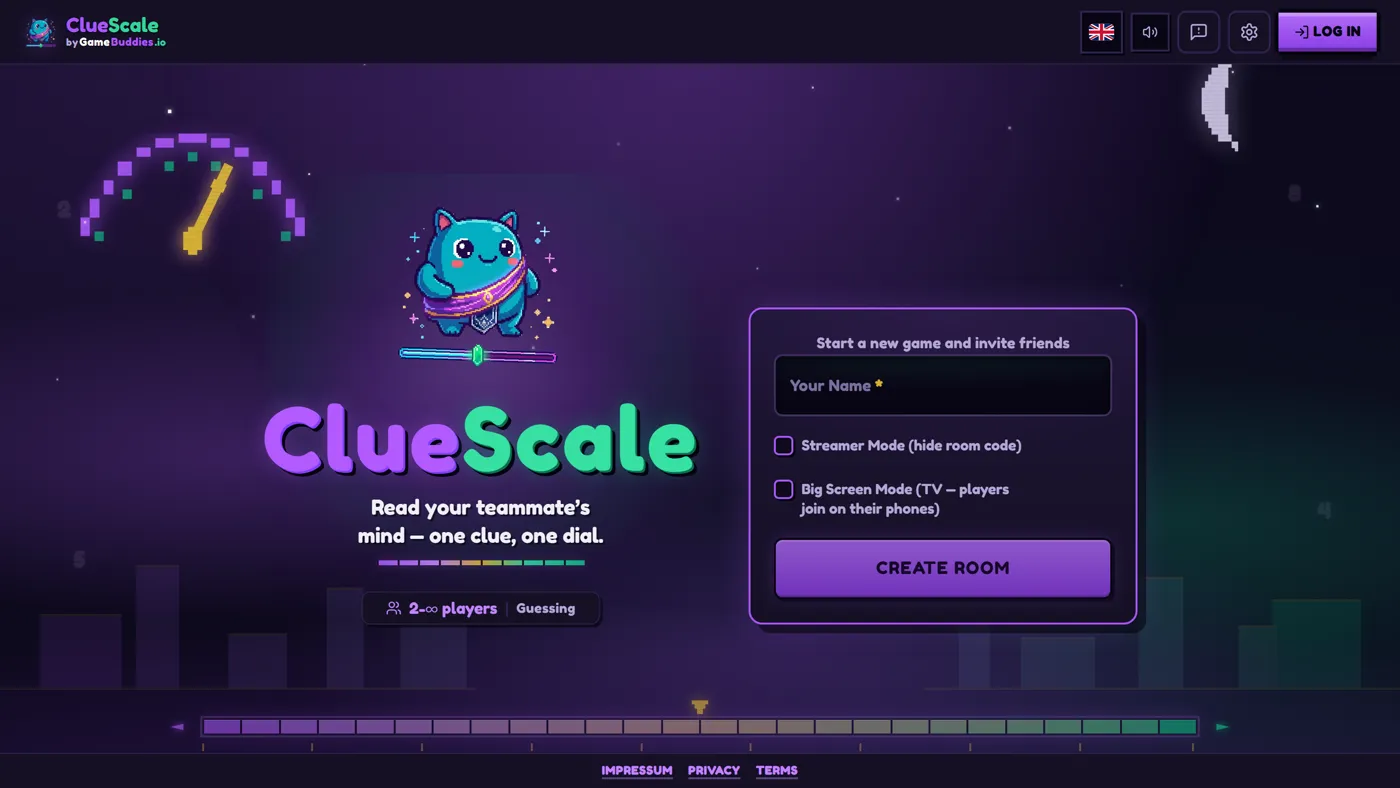
ClueScale is a scale-based clue game. One player knows a secret answer; the others have to guess it, but the clue-giver can only use a scale (hot/cold, big/small, silent/loud) instead of words. It's similar to Wavelength the board game but free and browser-based.
The 4-6 player sweet spot is where the scale becomes strategic — too few players and the answer is always obvious, too many and the discussion takes forever.
10. Letter Rush (2-8 players)
Letter Rush is competitive word-building. All players get the same letter set and a timer; longest word wins the round, ties broken by submission time. Rounds are 3-5 minutes and the competition gets vicious by round three.
Works for 4+ because the more players you have, the more pressure there is to find a word nobody else will — which rewards creativity over raw vocabulary.
How these 10 games compare
| Game | Players | Round | Best for |
|---|---|---|---|
| Canvas Chaos | 3-12 | 10-15 min | Mixed groups, casual drawing |
| Last Brain Standing | 2-10+ | 8-12 min | Competitive trivia |
| Bad Actor | 4-12 | 8-15 min | Social deduction, 6+ players |
| Bingo Buddies | 2-50+ | 5-15 min | Huge groups, events |
| Schooled | 3-30+ | 10-20 min | Classrooms, team-building |
| ThinkAlike | 2-8 | 5-10 min | Small mixed groups |
| Hot Potato | 3-16 | 3-6 min | Warm-ups, filler |
| Prime Suspect | 2-6 | 10-15 min | 4-player card games |
| ClueScale | 3-6 | 10-15 min | Strategic small groups |
| Letter Rush | 2-8 | 3-5 min | Competitive word play |
How to host a free online multiplayer game with 4+ friends
The host workflow is the same for every game in this guide:
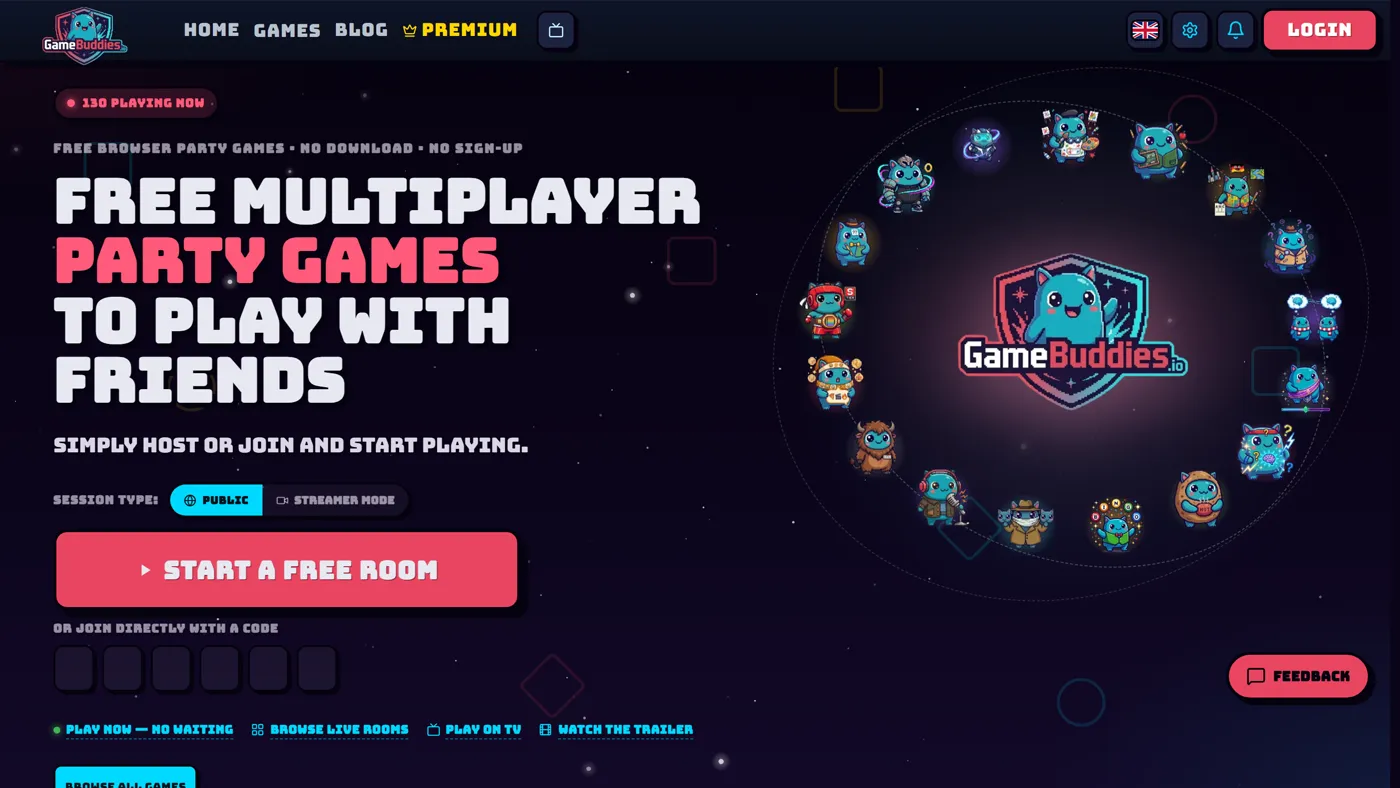
- Go to gamebuddies.io. On desktop or mobile — either works for hosting.
- Pick a game from the grid.
- Click "Create Room." You get a 4-letter room code.
- Share the code (or the URL with the code in it) with your friends — in Discord, a group chat, a work Slack, wherever.
- Everyone joins. They enter the code on the homepage or click the link. No account needed.
- Start the game when everyone's in.
The whole process takes under a minute the first time and about 15 seconds every time after that. No installs, no verifications, no credit cards.
What about paid alternatives like Jackbox?
Jackbox Party Pack is great — we're not pretending it isn't. But for "I want to play with friends right now, free, no friction," there are three problems:
- Price. Each pack is $30. The current pack (11) is $30. Pack 10 is $30. Pack 9 is $30. You're not downloading one pack.
- Host install. Someone has to own the pack and install it. If the host isn't on PC/console, the game doesn't happen.
- One game per session. You pick a game from the Jackbox menu and play that. GameBuddies.io lets a single room switch games mid-session without rebuilding the lobby.
For groups that play together often and have a dedicated "Jackbox night" host, Jackbox is still worth it. For everyone else, free browser alternatives do the job without the friction.
Free online multiplayer games FAQ
What's the best free online multiplayer game for exactly 4 players?
For exactly 4 players, Prime Suspect hits the best card-game balance, and Canvas Chaos and ThinkAlike both work well at 4. If you want something more competitive, Last Brain Standing at 4 players is fast and brutal.
Can I play free online multiplayer games on my phone?
Yes. Every game in this guide runs on iOS and Android mobile browsers. You don't need an App Store download — open gamebuddies.io in Chrome or Safari, same as you would on a laptop.
What's the biggest group size for free online multiplayer games?
Bingo Buddies handles 50+ players without slowdown. Schooled handles 30+. Canvas Chaos and Last Brain Standing start to feel crowded above 12 but still work.
Do free online multiplayer games need a fast internet connection?
No. The games on this list are text-, draw-, and click-based — not real-time FPS. They run fine on hotel Wi-Fi, mobile data, or the spare laptop your aunt uses for email.
How do guests join a game without signing up?
Guests open gamebuddies.io (or click the shared link), enter the room code, pick a name, and they're in. No email, no verification. The host controls the room; guests just play.
Start a game now: head to gamebuddies.io and pick any game from the grid. Or browse all free browser games to compare the full catalogue. For party game picks specifically, see the best free party games for game night.